POSTMASTECTOMY
RADIATION THERAPY
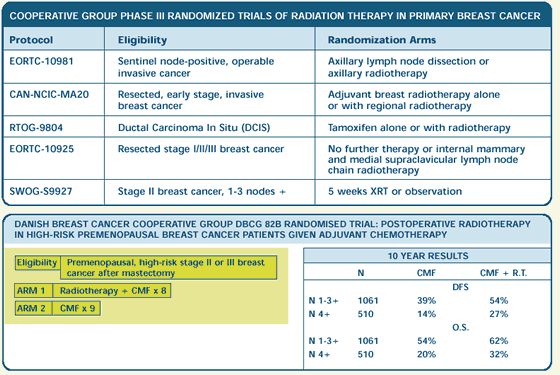
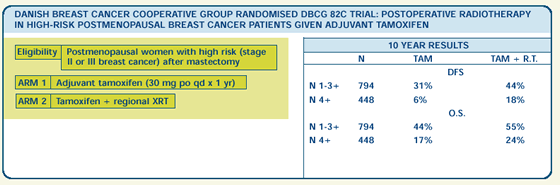
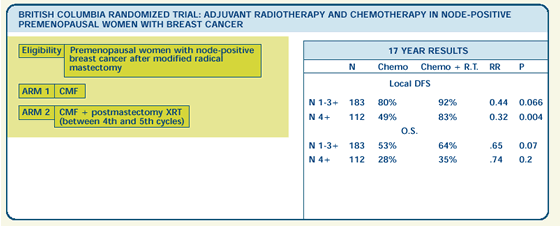
Recent trials have shown a survival benefit following
radiotherapy in all node-positive women, but the degree of benefit
is unclear in patients with one to three positive nodes. Part
of the dilemma is based upon the discrepancy in the rates of locoregional
failure without radiotherapy in those trials in comparison to
failure rates reported in American series. The recent report by
Recht and colleagues of the patterns of failure found in studies
conducted by the Eastern Cooperative Oncology Group notes that
the risk of locoregional failure was 13 percent at 10 years in
patients with one to three positive nodes. Although this is comparable
to the 16 percent actuarial rate seen in the British Columbia
trial at 10 years, it is strikingly different from the Danish
studies, where the crude rates of locoregional recurrence were
approximately 30 percent. Based upon these results, the statement
produced from the consensus conference convened by the American
Society for Therapeutic Radiology and Oncology to address the
controversies regarding patient selection for postmastectomy radiotherapy
stated that while there was a consensus that patients with four
or more positive lymph nodes should receive radiation therapy,
the data were less clear for patients with one to three positive
nodes.
—Lori
Pierce, MD
2000 NIH Consensus Conference. Abstract
INDIVIDUALIZING
DECISIONS ON POSTMASTECTOMY RADIATION THERAPY
This is a very interesting question that challenges
the concept we’ve had for so many years that breast cancer
is a systemic disease. While one can quibble with aspects of the
Danish and British Columbia trials, it is important that the subset
that seemed to benefit the most in terms of survival — women
with small tumors with a limited number of positive nodes —
is consistent with everything else we believe about aggressive
local-regional therapy. The ongoing Intergroup trial is very important.
This study is using modern radiotherapy techniques, and one would
hope that the incidence of late cardiac morbidity is going to
be very low. In a nonprotocol setting, we evaluate these one to
three node-positive cases individually and discuss radiation therapy
in patients with large nodal metastases, extracapsulary extension
and large primary tumors, particularly with lots of lymphatic
invasion in the breast.
We also discuss this option in a woman who is very anxious to
minimize her risk of failure and wants to opt for treatments that
may give very little benefit. Node-positive disease is a continuum.
I suspect that this will also be true of the benefits of postmastectomy
radiation therapy.
—Monica
Morrow, MD
CONTINUUM
OF POSTMASTECTOMY RADIATION THERAPY BENEFITS
Some of the controversy in the one to three node subset is quite
akin to what happened in adjuvant chemotherapy early on in its
development. We used to think that patients with large numbers
of nodes benefited, but patients with small numbers of nodes did
not. Then we recognized that patients with small numbers of nodes
benefited, but we thought patients with no nodes did not. Now
we recognize that even patients with no nodes in certain subsets
can benefit. This principle applies across the spectrum of disease
that systemic chemotherapy reduces risk of failure; however, the
absolute benefit is harder and harder to see as the absolute risk
of failure gets smaller. I think the same must be true in postmastectomy
chest wall radiation. It almost certainly must help patients with
one to three positive nodes. The question is, “What is their
absolute risk of failure and is the benefit of the reduction conferred
by postmastectomy chest wall radiation worth taking?” With
the uncertainty surrounding the one to three node-positive group,
we have proposed a trial for both pre- and postmenopausal patients
to assess this. This trial — sponsored through SWOG —
is now open and will be run through the Intergroup. There is a
huge subgroup of women out there who fit into this category, and
we hope that clinicians will enroll their patients in this study.
—Allen
Lichter, MD