RATIONALE
FOR AXILLARY DISSECTION
There are three reasons to do axillary dissection:
regional control, staging and to improve survival. For staging,
we have got enough literature from around the world to tell us
the accuracy of sentinel node biopsy. For regional control, surgery
results in almost 100% control, as does radiation therapy, so
before we abandon something that works very well, we have to be
very careful. We don't have any long-term data on regional control
for sentinel node biopsy. Regarding the issue of survival —
and I know it is a little heretical to say this — there may
be a survival advantage in controlling the axilla. The few studies
that looked at this were done in an era when we randomized hundreds
of patients, not thousands of patients. So the statistical power
was not there.
I've personally never done a sentinel node procedure in a breast
cancer case outside of a clinical trial. I'm not going to say
that it shouldn't be done — this is a judgment call. But
in terms of making the claim that sentinel node is as good as
axillary dissection, we don't have the data and we are in an era
of evidence-based medicine.
—David
Krag, MD
RATIONALE
FOR ACOS Z-11
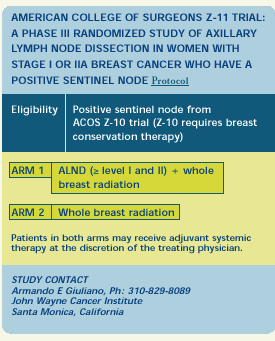
Many surgeons believe that axillary dissection
is therapeutic, and they are reluctant not to perform axillary
dissection in sentinel node-positive patients.
However, a number of randomized studies have failed to show that
axillary dissection improves survival. In sentinel node-positive
women, the sentinel node may be enough because often it's the
only involved node.
In addition, virtually all node-positive women in this country
receive adjuvant systemic therapy, which may take care of any
residual problem in the axilla. Many patients are also receiving
opposed tangential field radiation, and that's partial axillary
radiation. In studies where patients received lumpectomy with
radiation and no axillary dissection, the axillary recurrence
rate was extraordinarily low. I think ACOS Z-11 is a very important,
very justifiable and ethical trial. For an operation that's been
used for 100 years, it's time to answer the question about the
need for axillary dissection.
—Armando
Giuliano, MD
CLINICAL
TRIALS OF SNB
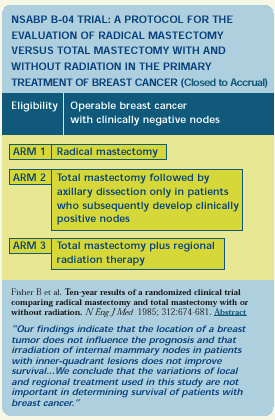
NSABP trial B-04 showed no difference in survival
outcome between axillary dissection at the time of diagnosis and
delayed axillary dissection if clinically positive nodes developed.
Since that trial didn't show a survival difference, is it reasonable
to expect that NSABP B-32 would? I think that's a very open question.
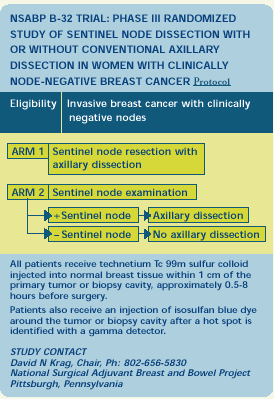
However, B-32 will tell us about the clinical false-negative rate
when lots of surgeons do sentinel node biopsy, which is an important
issue to inform patients about.
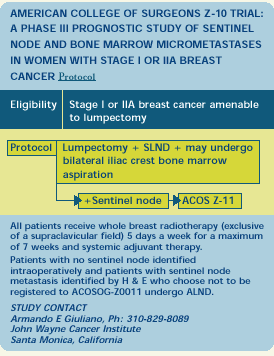
The ACOS trial addresses the much more controversial question
of whether there is a reason to remove axillary nodes after the
patient has been staged as node-positive. It challenges the dogma
that people have had for years.
—Monica
Morrow, MD
ACCRUAL
TO SENTINEL NODE TRIALS
Sentinel node mapping is becoming a victim of its
own success. As surgeons realize that it is not a terrific technical
feat to learn how to do this, and as more patients become aware
of it through the Internet and other sources, it will become harder
and harder to find both patients and physicians willing to participate
in randomized clinical trials.
—Patrick
Borgen, MD