MECHANISM
OF ACTION
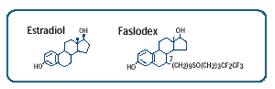
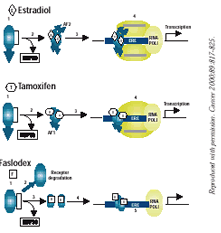
If you look at drugs that interact with the estrogen receptor,
estrogen is on one end of the spectrum, stimulating most genes
under its control after binding to the estrogen receptor. Drugs
like tamoxifen stimulate some genes and inhibit others, depending
on the tissue and gene. At the far other end of the spectrum,
drugs like Faslodex seem to have a pure antiestrogenic profile
on all genes with none of the agonist qualities of tamoxifen.
—C
Kent Osborne, MD
SECOND-LINE
METASTATIC TRIALS OF FASLODEX VERSUS ARIMIDEX
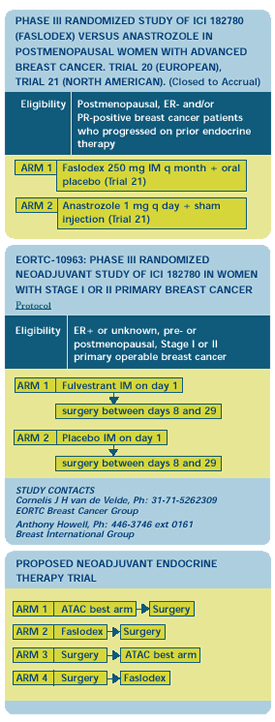
In terms of efficacy, Faslodex was at least equal to treatment
with a third-generation aromatase inhibitor, which currently is
our best endocrine therapy for postmenopausal patients.
There were also some hints that Faslodex might be a bit better,
mainly in the North American trial 21, where the overall rates
of objective response and clinical benefit were slightly higher
for Faslodex, though not statistically significant.
The duration of response in Trial 0021 was significantly better
for Faslodex and was of a magnitude that is clinically and humanly
worthwhile in the metastatic setting. These results suggest that
perhaps this agent also might give an extra boost as adjuvant
therapy which will be tested in clinical trials.
—Richard
Elledge, MD
TRIAL
DESIGN
The European trial and the American trial are a little bit different
in their structure and results. The American trial — which
I think has a better design — was a double-blind study. Patients
assigned to Arimidex received placebo injections. So, it’s
clearly blinded. Also, because the patients in both groups had
to come to the clinic once a month, there was consistency with
regard to the patient being seen.
The
European trial was not double-blinded. The patients on Arimidex
were seen every three months, while the patients on Faslodex were
seen by someone every month. This design has the potential to
have some bias in terms of identifying when the patient progresses.
Patients in the Faslodex group of the European trial were seen
more often, and conceivably progression would be identified a
little earlier than in an Arimidex patient.
Having said that, the results show similar response rates between
the two drugs, but in the American trial, the response duration
is about twice as long for Faslodex compared to Arimidex. We have
to keep it in mind that aromatase inhibitors are very good agents
in and of themselves, and in one of these new trials, Faslodex
is at least as good as Arimidex, and in the other we see an advantage
at least in one important parameter.
—C
Kent Osborne, MD
PATIENTS’
REACTIONS TO FASLODEX
The monthly intramuscular injection doesn’t seem to be much
of a deterrent. For older patients where there may be a compliance
question, the injection may be a plus. Also there are some patients
where reimbursement may be more favorable for an injectable agent.
Other patients may not like the idea of an injection or coming
to the doctor’s office once a month — they prefer a
pill. Efficacy will be the key determining factor though, particularly
if we move to the adjuvant setting.
—
William Gradishar, MD
EORTC
STUDY 10963
The preoperative EORTC trial evaluates one injection of Faslodex
after the diagnosis of breast cancer has been made but before
surgery. The idea is for the Faslodex injection to cover the operative
period as a potent antiestrogen that will lower estrogen receptor
levels. We want to test the hypothesis of Bernie Fisher and others
that adverse events related to metastases occur during the perioperative
period, and hopefully we can alter that with Faslodex. The aim
is to put more than 3,000 women into this study.
—Professor
Anthony Howell, FRCP
PROPOSED
NEOADJUVANT TRIAL
We are looking for a trial to replace ATAC and are considering
evaluating conventionally timed versus perioperative endocrine
therapy. Faslodex lends itself to that because of its rapid effects
on the tumor in situ, and you can measure surrogate markers. We
would like to take the best arm of ATAC and compare that with
Faslodex in a factorial way — looking at drug against drug
and timing against timing. Hopefully, we’ll have a pilot
protocol ready to go next year. This type of trial — where
you’re looking at the tumor intact — can be a gold mine
in the search for the valuable surrogate markers of response.
—Michael
Baum, ChM, FRCS