THE
ATAC TRIAL
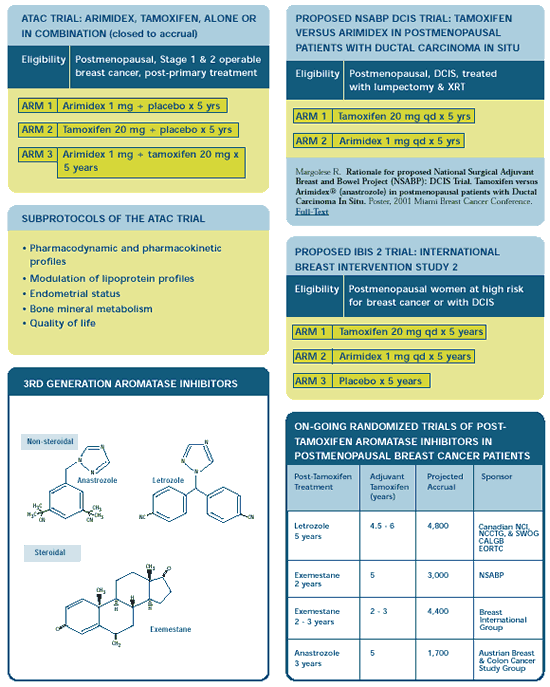
I chair the steering committee of the ATAC trial and have seen
this trial through from back-of-an- envelope discussions in a
pub years ago to completing accrual of more than 9,300 patients
in record time. It's an amazing international collaboration —
particularly an Anglo-American collaboration. The interim analysis
from the Data Monitoring Committee at the end of last year advised
us that there was no excess of predetermined adverse events; in
other words, the drugs and the combinations seem to be as safe
as expected. There is something like 30,000 women-years of exposure
to Arimidex, so we have a really good handle on its safety profile.
We already know about the pharmacokinetics and pharmacodynamics
of the inter-action of anastrozole and tamoxifen. We should be
ready to present the initial data at the end of this year.
—Michael
Baum, ChM, FRCS
ADJUVANT
AROMATASE INHIBITOR TRIALS
I am impressed by the data from the large aromatase inhibitor
trials in first-line metastatic breast cancer, and on that basis,
we have the hypothesis that the same type of comparison in the
adjuvant setting may have a similar or magnified outcome. But
we will have to wait to see the data.
—Gabriel
Hortobagyi, MD
PROPOSED
NSABP DCIS TRIAL
The driving force of current research is to move away from the
concept that DCIS is simply a surgical problem — and that
if you obtain 10 mm margins, the patient is cured and no adjuvant
therapy is needed. Even if we take out the index DCIS, the risk
for these women to have another tumor in either breast in the
future is at least as high or higher than the risk for women in
the NSABP P-1 prevention trial. So, chemoprevention in DCIS is
an important issue, and we need to find out how to do this best.
The ATAC trial, which has past accrual and is nearing analysis,
will answer the question about anastrozole in invasive breast
cancer. We need to ask the same question in noninvasive disease.
—Richard
Margolese, MD
PROPOSED
IBIS 2 PREVENTION TRIAL
This will be an international trial, and we have two good models
for big multinational trials — the ATLAS trial of tamoxifen
duration and the ATAC trial — which ran very similar treatment
arms to IBIS 2. The entry criteria of IBIS 2 will be similar to
IBIS 1, but restricted to postmenopausal women. We don’t
use the Gail model. Family history is factored in, along with
nulliparity and pathologic entities such as atypical hyperplasia
and LCIS. We’re also adding a new category of women who have
mammographic dysplasia covering 50 percent or more of their breasts.
That links it in nicely with screening which is really where prevention
belongs. Screening programs should not only detect small cancers,
but also identify women at high risk and offer them preventative
strategies. IBIS 2 is also going to have a DCIS component. The
trial will enter 12,000 high-risk women and another 4,000 patients
with DCIS.
—Jack
Cuzick, PhD
TRIALS
OF AROMATASE INHIBITORS AFTER TAMOXIFEN
We've got adjuvant studies that look at aromatase inhibitors given
after tamoxifen. The question now is, are those studies going
to be relevant anymore? Is it really the studies that use aromatase
inhibitors up front that are going to be the ones we're interested
in? We may have a whole group of large studies with interesting
information that we may not use, because we won’t be giving
the drugs that way anymore.
—Kathleen
Pritchard, MD