ADJUVANT
CHEMOTHERAPY FOR EARLY BREAST CANCER
The seminal studies that demonstrated that long-term chemotherapy
could have an important survival advantage emerged from the National
Surgical Adjuvant Breast and Bowel Project, led by Professor Bernard
Fisher, and the historic trial of cyclophosphamide, methotrexate
and fluorouracil led by Dr Gianni Bonadonna in Milan. It was probably
this second trial more than any other that established the role
of adjuvant chemotherapy in the management of early breast cancer.
Many subsequent trials have attempted to fine-tune or better select
the optimum duration and combination of cytotoxic drugs.
—Michael
Baum, ChM, FRCS; Joan Houghton BSc
Br Med J 1999;319:568-571. Full-Text
ADJUVANT
TAXANES
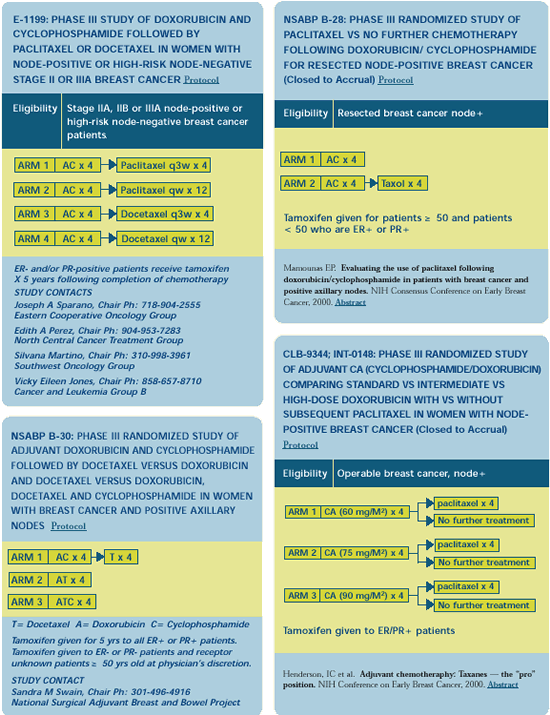
It is necessary to wait for future results of ongoing trials before
pronouncing judgment on the value of taxanes in the adjuvant setting.
It is also necessary to better define the population most likely
to benefit from therapies of longer duration, intensification
and multiple regimens. It no longer is reasonable to judge all
breast cancer patients as having equal probability of benefit
from a given therapy.
That was a paradigm that worked well when adjuvant chemotherapy
for breast cancer was in its infancy and little was known about
the molecular heterogeneity of breast cancer. It is now of critical
importance to design trials with the aid of molecular tumor profiles
with potential predictive value to prospectively identify the
subgroup most likely to benefit from the addition to therapy of
taxanes and other new drugs.
—Martine
J Piccart, MD, PhD et al.
NIH Consensus Conference 2000. Abstract
ADJUVANT
THERAPY FOR LOW-RISK PATIENTS
Sometimes we neglect using some fairly well-established, reproducible
prognostic factors. The SEER data and the American College of
Surgeons’ National Cancer Database cannot reliably identify
a subset of node-negative patients with tumors under a centimeter
with a long-term survival of less than 90 percent.
There are also very good data showing that patients with histologic
grade one tumors that are 1.1 to 2 centimeters have a survival
that’s greater than 90 percent.
Patients with grade one tumors are overwhelmingly ER-positive,
so endocrine therapy is certainly a reasonable choice there. But
the added absolute benefit of chemotherapy in this subset is extremely
small, and sometimes that is not conveyed to women in a way that
they can understand. Another group is the special histologic subtypes,
most notably tubular carcinoma but also mucinous carcinoma.
Even a two to three centimeter tubular cancer has an outstanding
prognosis, and again, these are receptor-positive. So, if physicians
look at old consensus guidelines and just go in lock-step with
the greater-than-1-centimeter number, they might potentially overtreat
some patients by using chemotherapy.
—Monica
Morrow, MD