NSABP
P-2: THE STAR TRIAL
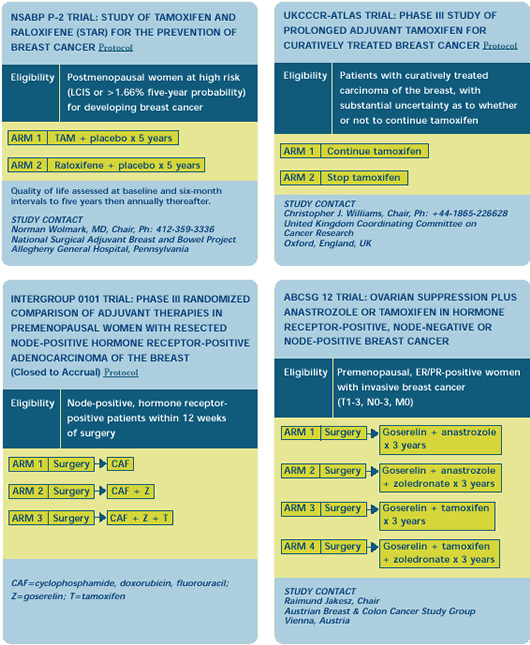
There is a great deal of enthusiasm for the STAR
trial, and an enormous amount of credit has to go to the NSABP
members who are committed to moving the state-of-the-art forward.
That’s their primary commitment, and it was the primary commitment
of the 13,388 selfless and courageous women who entered the P-1
trial. And I believe that there will be 22,000 more women out
there who will enter P-2.
—
Norman Wolmark, MD
RALOXIFENE
Raloxifene has been studied in a completely different
population, namely older postmenopausal women selected for osteoporosis
risk, and some data suggest that women with decreased bone density
are at decreased breast cancer risk. The raloxifene data on breast
cancer risk reduction is promising, but right now for postmenopausal
women who are at increased risk, tamoxifen is clearly the drug
of choice outside of a clinical trial. Also, raloxifene is only
for postmenopausal women; there are no safety data in premenopausal
women.
—
Monica Morrow, MD
DURATION
OF TAMOXIFEN THERAPY
Breast cancer is a disease with at least a 20-year
natural history. The question is, “Would 10 years of tamoxifen
be better than five years for providing protection against recurrence
in the second decade after diagnosis?” There are almost as
many breast cancer deaths in the second decade after diagnosis
as in the first. We’ve really got to think on a long-term
scale. When we do that, the idea that 10 years might be better
than five years actually becomes quite interesting. We’ve
got virtually no information on that second decade.
—Richard
Peto, FRS
INTERGROUP
0101 STUDY OF ADJUVANT OVARIAN ABLATION
The study was designed a long time ago, and at
a time when there was increasing interest in ovarian ablation
because of the meta-analysis and because there were now drugs
available that could lead to chemical castration as opposed to
surgical ablation.
In
the best of all worlds we would have had a 4th arm of CAF followed
by tamoxifen, but at the time we weren't sure that we could accrue
to that trial in a timely fashion and have something to talk about.
The
disease-free survival was better for the group receiving CAFZT
compared to CAFZ. There was a borderline impact of CAFZ compared
to CAF. An unplanned preliminary, retrospective subset analysis
demonstrated that younger women — arbitrarily defined as
women under the age of 40 — seemed to do better with Zoladex®(goserelin
acetate implant). Perhaps that's not surprising, because those
women are the least likely to be made postmenopausal by chemotherapy.
There's also a suggestion that women with premenopausal estrogen
levels after chemotherapy were destined to derive benefit from
Zoladex. The big clinical question now is what to do with the
young woman who is premenopausal at the end of chemotherapy? Most
of them receive tamoxifen as a matter of routine, and I personally
am not using LHRH agonists in that situation right now, but some
of our very good colleagues have looked at these trial results
and said that they think it is legitimate to do.
—
Nancy E Davidson, MD
ADJUVANT
OVARIAN ABLATION
We now have several trials demonstrating that in receptor-positive
premenopausal patients, ovarian ablation is as effective as CMF
— and, in fact, there’s almost a suggestion that it
is better. In the ECOG study (Intergroup 0101), patients received
CAF, which everyone would consider state-of-the-art chemotherapy.
In that trial, there was additional benefit from adding ovarian
ablation to CAF — certainly among women under age 40. That
study really changed my thinking, and I have now moved to the
point that if a woman receives adjuvant chemotherapy and does
not stop menstruating, I routinely add the LHRH agonist, Zoladex,
with tamoxifen.
—
I Craig Henderson, MD
AUSTRIAN
TRIAL: ABCSG 12
The basis for this trial was a study presented at ASCO whereby
patients were randomized either to CMF or to Zoladex plus tamoxifen.
This was in premenopausal, ER-positive patients, and what it showed
was that the early recurrence-free survival curves were in favor
of the endocrine arm. And so they have taken that as the control
arm for the next study, and they’re now comparing Zoladex
plus tamoxifen to Zoladex plus Arimidex.
—
John F Robertson, MD, FRCS