NEOADJUVANT
CHEMOTHERAPY
I view induction chemotherapy as a positive trend, because you
do not lose anything, and there is a higher likelihood of being
able to do a lumpectomy with a much better cosmetic result. It
also provides an in vivo chemosensitivity assay. This trend will
also allow us to start looking at minimally invasive surgery to
the primary tumor. I predict that in the next decade we will move
away from axillary node dissection, and sentinel node biopsy may
be a transition maneuver in this regard, because people do not
yet feel totally comfortable giving up the nodal status information.
But once we start using systemic therapy first, the remaining
question relates to treatment of what’s left of the primary
tumor. The research question then would be, "Do you need
to take the patient to the operating room at all?"
—
Eva Singletary, MD
NEOADJUVANT
ENDOCRINE THERAPY
Neoadjuvant therapy allows you to determine in a couple of months
whether or not an agent is going to have a favorable impact as
opposed to giving a drug blindly for years after local therapy
and hoping that it will do good. There are a lot of data for chemotherapy,
and I am certain that similar data will emerge for endocrine therapy.
The studies that were done in ER-positive, postmenopausal women
showed a very high degree of antitumor activity in patients treated
with aromatase inhibitors. In one trial, anastrozole showed dramatic
tumor reductions — 70% or 80% of the patients showed objective
shrinkage of their disease, and close to two-thirds of the women
became candidates for breast preservation after approximately
four months of therapy with anastrozole.
—Aman
Buzdar, MD
TRIALS
OF NEOADJUVANT ENDOCRINE THERAPY
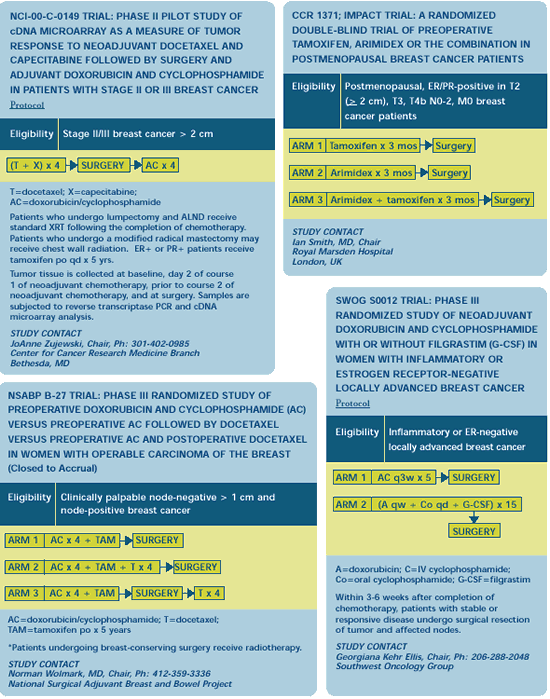
We’ve been involved in a number of randomized neoadjuvant
trials. The IMPACT study is in a neoadjuvant setting, with the
same therapies being evaluated in the ATAC adjuvant trial. From
our prior work, we know that anastrozole and tamoxifen have different
biological effects on tumors. Anastrozole switches off proliferation.
If you look at the tumor before starting anastrozole and then
three months later, in about half of the patients the actual histologic
grade changes — it downgrades the tumor. But the reason it
downgrades is because proliferation is turned off.
If you look at tamoxifen, about half of the patients will also
downgrade, but the downgrade is completely different. What you
see is an increase in glandular differentiation. Tamoxifen also
tends to induce the progesterone receptor, while anastrozole switches
the PR off completely.
These observations fit with the fact that different clinical activities
have been seen with aromatase inhibitors, which are actually more
effective than tamoxifen. So, we’re starting to understand
that there’s not one pathway for endocrine therapies. And,
of course, if they act by different mechanisms, then combinations
— like in ATAC — could be more effective than one agent
alone.
You can get a very good idea of what’s happening in tumors
by looking at biological markers rather than clinical endpoints.
In these studies we’ve been taking biopsies at 10 to 14 days
and looking at what effect drugs have on proliferation, cell death
and a variety of genetic markers to see if we can start to predict
very early on whether the patient is going to get a benefit from
a drug. And that is potentially a very useful tool, because a
lot of patients wait 10 to 14 days (at least in the U.K.) from
the time of diagnosis to the time of surgery.
If you got a core biopsy at the time of diagnosis and you put
a patient on a drug and then you operate on them and you see that
that drug has done something to the tumor and you know that that
change is associated with long-term benefit for a patient, then
you have a potential method to individualize treatment.
—
J Michael Dixon, MD, FRCS