TARGETED
SYSTEMIC THERAPY
Herceptin is clearly one of the major triumphs of the last few
years. It’s exciting on many levels — largely because
of the clinical benefit, but also because of the way it opens
up a new era of science and integration into the clinic.
...Following on the heels of Herceptin, we are all very enthused
about the kinase inhibitors — agents like Iressa® (ZD
1839) — which will be, to a greater or lesser extent, HER-targeting
drugs, acting against the epidermal growth factor receptor or
members of the EGFR family. And that may have an impact either
as single agent therapy or, arguably, in combination with conventional
chemotherapy, just the way that Herceptin has had an impact. Also,
as we get our act together regarding microarray assays and gene
expression, we are going to begin to separate patients in a way
that conventional light microscopy does not allow. I’m optimistic
that this information will allow for better treatment of patients,
and maybe even allow us to select specific therapies for specific
patients. Look at the benefit of tamoxifen in the Overview. Is
that because tamoxifen is a powerful drug, or because we select
a subset of patients — ER-positive patients — where
we demonstrate a large benefit?
—Clifford
Hudis, MD
SURVIVAL
ADVANTAGE IN METASTATIC DISEASE
We found that trastuzumab-based combination therapy was effective
in that it reduced the relative risk of death by 20 percent at
a median follow-up of 30 months. Few studies of metastatic breast
cancer have demonstrated a survival advantage of this magnitude
in association with the addition of a single agent.
...Given the extremely poor prognosis of patients with HER2-positive
metastatic breast cancer, the cardiotoxicity of trastuzumab must
be weighed against its potential clinical benefit. We recommend
a cautious approach to the use of trastuzumab in patients who
have previously received anthracyclines and in those who are currently
receiving anthracyclines. The adjuvant (postoperative) use of
trastuzumab will be an important research topic, but since many
patients with early-stage breast cancer can be cured by surgery
and radiotherapy, the cardiotoxicity of trastuzumab will be a
critical consideration.
In this context, the risks of trastuzumab will necessitate great
caution in its use, especially when it is combined with an anthracycline.
Indeed, one large upcoming trial of adjuvant trastuzumab will
evaluate a nonanthracycline-based regimen for this reason.
—Dennis
J Slamon, MD, PhD et al.
N Engl J Med 2001;344(11):783-792. Abstract
TRASTUZUMAB
AS ADJUVANT THERAPY
There is a powerful emotional and intellectual appeal to translate
the survival gains from the use of trastuzumab in the advanced-disease
setting to the adjuvant treatment of HER2- overexpressing breast
cancer, particularly with those at greatest risk of recurrence
and death.
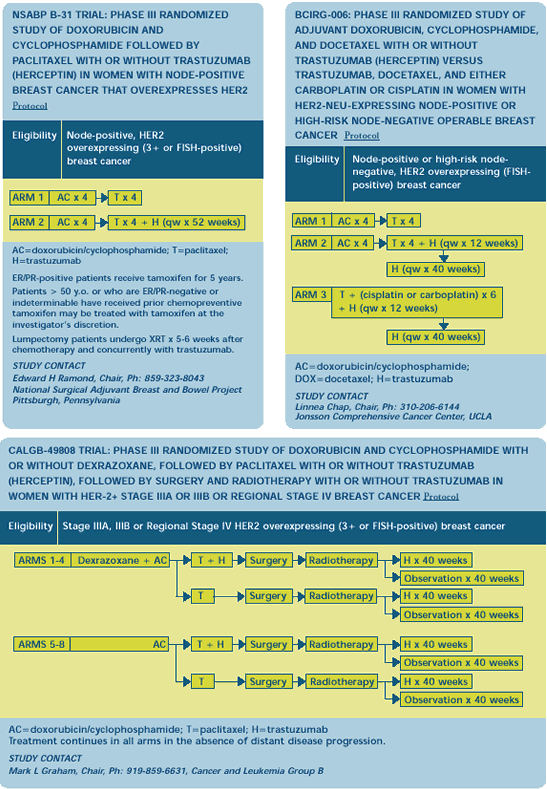
The undetermined long-term risk of cardiac problems from trastuzumab,
however, demands caution, and use of the agent as adjuvant therapy
is best restricted to participation in the several clinical trials
that are now underway. Eligibility for these trials generally
require tumors to have IHC 3+ or FISH-positive HER2 results and
a pretreatment EF > 50%.
—John
Horton, MB, ChB, FACP
Cancer Control 2001;8(1):103-110. Full
Text
HER2
REPRODUCIBILITY
Consensus regarding the best methods, reagents, or cut-off points
to define HER2 status for determining trastuzumab responsivity
has not yet been reached. HER2 testing for other prognostic or
predictive purposes, e.g. to determine whether patients are likely
to respond to other agents, such as dose-intensive doxorubicin,
may be less. Data from the Cancer and Leukemia Group B trial 8541
(companion 8869) suggest that, with proper controls in high-volume
laboratories, many of the available methods produce comparable
results.
—Ann
Thor, MD
Ann Oncol 2001;(Suppl 1):S101-S107. Abstract